Friday, 4 November 2011

Top 10 Contemporary Political Artists: 4, Los Casagrande

Berlin, August 2010: Chilean Art Collective Los Casagrande drop 100,000 bookmarks with poems by 80 German and Chilean poets from a helicopter over Berlin.  Berlin was, of course, the logical conclusion to their "poetry rain" project which had previously taken place in Santiago de Chile (2001), Dubrovnik (2002), Gernika (2004) and Warsaw (2009).  As the Guardian points out all cities which, like Berlin, have suffered aerial bombings during their history.

Warsaw Poetry Rain

But Berlin is particularly poignant given the Berlin Blockade of 1948-9.  After WW2, and before the Berlin Wall, Germany was divided in two with East Germany falling under the control of the Soviet Union.  Berlin, entirely in East Germany, was subdivided into sectors controlled by the Soviets (East Berlin) and the US, Britain and France (West Berlin).  In June 1948 the Soviets blockaded all roads and railways controlled by the Western Allies, thus making the Soviets the sole suppliers of food and fuel and thereby gaining effective control over the whole city.  In response the Western Allies organised the Berlin Airlift, dropping supplies by air into West Berlin.  In one year they made 200,000 flights and by April 1949 they were supplying more by air than they had by land.  The US and Royal Air Forces mobilised by dropping food and fuel (not bombs) as an act of (cold)warfare against the Soviet Union.

Subimos al helicoptero

Watching the Warsaw Poetry Rain (above) reminds me of a KISS concert I was at, in Donnington.  Paul Stanley made a rare speech concerning the political malaise before saying "... every now and then you owe it to yourself...........to ROCK N ROLL ALL NIGHT AND PARTY EVERY DAY!".  This was followed by the song of the same name and an explosion from which thousands of Rizla-esque pieces of paper fell from the night sky like a ticker tape parade.  The show won me over as a KISS fan.  The audience were gripped by a mix of Rock music and "ooh...ahhh!" moments derived from firework displays and, the ticker tape parade.  It was magical, it was fun.  Watch the video of the Warsaw Rain and you'll see the look of delight on the faces of adults and children alike.  Everyone likes a spectacle and everyone likes something for free.  But look closely and you'll also see middle-aged men studiously perusing the bookmarks.  The drop elicited two primary reactions: joy and intellectual reflection (what does this mean?).  In this way Casagrande successfully engaged their audience, their audience being regular street passers-by - not gallery going art lovers... and this is important.  Remember this: Casagrande's projects will not make them money (they rely on grants to realise them at all), they do not gain individual fame (as they are a collective), they do not seek approval or regonition from art-lovers (as they confront anyone and everyone).  It is a protest, for sure (against war).  It is organised distribution of art (poetry) and ideas.  I love the idea that someone today might be looking at their bookmark and fondly remembering the day they caught it, falling from the sky.  Or they might be driving or walking somewhere and think about it.  They might even re-read the poem and reflect on the current malaise.  The art lives on in memory - and in a book mark. 

What if you can't get hold of a helicopter?  In 2008 the Georgian author David Tursashvilli, part of the group GWARA (an acronym for Georgian Writers Against Russian Aggression) led a more low-fi protest against the Russian attacks on Tbilisi.  He took his children to the bottom of the garden with the intention of burning all the Russian books in the house.  He then changed his mind and decided to give them back to Russia, at the Russian embassy.  He "bombed" the embassy with paper aeroplanes made from the pages of the books.  You can read more about it here. 


Berlin Poetry Rain

Wednesday, 2 November 2011

Top 10 Contemporary Political Artists: 5 Simon Starling

Simon Starling fashions himself as a kind of alchemist, an artist whose primary interest is in how he can change one substance or object into another.  But clearly he is a political artist.  The transformation of substances has an immediate and obvious link to ecological issues - GM crops for example.  He also serves as an ideal model for an artist who, through his actions, allows us to imagine unusual alternatives.  His work gives us hope, for change or hope that we can overcome current difficulties, but it is also satirical.  Starling's work shows up how absurd humankind's attempts can be - his work often focuses on the amount of labour needed to achieve humble results.

In Quicksilver, Dryfit (1999) Starling went to Suriname (a former Dutch Colony) to get aluminium ore from which he made a boat which was sailed down canals in Amsterdam.  The boat was then cut in half and Starling used the Aluminium to make counterfeit copies of the original lumps of aluminium ore.  This can be seen as a critique of Modernist notions of progress.  It is also a comment on (post)colonialism and the history of sculpture.

Shedboatshed (Mobile Architecture No 2) 2005
Shedboatshed (Mobile Architecture No 2), perhaps Starling's most famous work, is similarly a comment on progress.  Starling found a shed on the Rhine upstream from the Museum für Gegenwartskunst, in Basel, Switzerland.  He then dissembled it and turned it into a boat.  Not just any boat, one should say, but a Weidling - a type of boat indigenous to the local area.  Starling punted the boat down the Rhine to the gallery where it was transformed back into the shed for display in the exhibition.  But it's not the lack of progress that the viewer ends up dwelling on - it's the history.  Starling is clearly interested in history (as demonstrated in the specific type of boat he chose to make) and this history is evident in the final shed.  The end product is not the same as the original shed: it is scarred by the cuts needed to turn it into a boat; it is pitted with holes where bolts used to be.  Starling would love Chatham Historic Dockyard, where the buildings that were once used to make rope, sails, and all components of Royal Navy ships are made out of recycled Royal Navy Ships.  You can literally see the history in the beams and rafters of the buildings.  Notably, the title for Starling's retrospective at Tate St Ives earlier this year was "Recent History".

The Long Ton (2009)
In "Recent History" Starling exhibited The Long Ton (2009) - two massive chunks of stone: one a piece of marble from Carrara and the other a much cheaper, but far heavier marble from China.  After the long journey from China, the Chinese marble has approximately the same market value of the Carrara marble despite the fact that it is four times the size and despite the difference in weight the two hang in perfect harmony.  In the Guardian last February, Jonathan Jones questions whether Starling's works actually achieve his goals: to communicate big questions and issues explored through his research and journeys.  He does recognise Starling as "an artist of big ideas" but he claims the ideas lie outside rather than inside the work.  I disagree.  Starling's strength is that, by presenting artifacts or remnants of a journey or process, he asks us to consider what has actually happened and what has philosophically changed.  I doubt Starling would apologise for his work being challenging, not that I think it is all that challenging.  Take the example of Long Ton, it is actually quite easy to see the metaphor: that although something from China is much heavier, something from Europe punches above its weight.  You are quickly drawn into thinking how this might be: If Carrara marble is from Italy and the other stone from China, should we be thinking of Marco Polo? How does the balancing mechanism work? How do global markets work (today)? Are there dark forces behind this apparent harmony? What tips the scales in favour of the west?  What is the history behind such issues?  Surely that's the point. 
I'm not even sure that Jones is convinced by his argument which he seems to undermine in the same article.   Firstly, Starling's works feed off one another.  It comes as no real surprise that an artist who is investigating recurring themes will revisit facets of these themes in different works.  If the history behind the economic relationship between Europe (Italy in particular) and China was not evident in the Carrara marble and cheap Chinese stone then other works in the exhibition can help draw our attention to historical matters.  Archaeopteryx Lithographica (2008-9) is overtly about history, it is also made from a slab of stone - this time limestone into which Starling has imprinted a feather from the earliest fossilised bird.  Jones tells us that Starling has selected limestone from the same Bavarian quarry where the earliest, most primitive bird fossil was found.  I feel that Starling is giving us a message - all the facts and information are there but it's up to us how much we uncover.  And through uncovering and discovering for ourselves we are more likely to be touched and moved than if Starling were to merely tell us a story.  Also, through our own investigation we can come to our own conclusions and take ownership of the ideas we come to.  It's up to us how much imagination we put into the mix.  It's up to us to imagine where this might lead in future works, or in contemporary issues.  Jones ends his review by saying he has no doubts about the "Coup de grace" of the exhibition which is "discombobulating in every sense". For this piece Starling made a steam powered boat and sailed it on a Scottish Loch with a friend.  Still in the Loch, they began to destroy the boat by sawing it apart until it sank.  This event was recorded and exhibited as a slide show at the Pier Gallery in Orkney.  Starling then remade a full sized replica of the Pier Gallery for the Tate Show, literally at the other end of the British Isles, where he showed the slides again. 
Autoxylopyrocycloboros (2006)

According to Jones:
"...the mad commitment of it all – building your own boat, sinking it, rebuilding a gallery in the Orkneys near to Land's End – is hilarious, lovable and compelling".
Life goes on.  Destroyed artwork lives on, remade and put into new contexts.  Through positive action comes new possibilities.  This brings my attention back to another piece Starling made before winning the Turner Prize in 2005: Tabernas Desert Run (2004). Starling overtly displays environmentalist concerns and credentials in this work by crossing the Tabernas desert in Spain on a homemade electric bicycle whose only waste product was water.  He then used the water to make a watercolour painting of a cactus.  According to the Tate:
Tabernas Desert Run (2004)
"The contrast between the supremely efficient cactus and the contrived efforts of man is both comic and insightful, highlighting the commercial exploitation of natural resources in the region".

Barge Haulers on the Volga (1870-73)
 Starling's work itself is sometimes absurd, comical, and always seems to comment on the inefficiency of labour.  This reminds me of Ilya Repin's 1870-1873 painting Barge Haulers on the Volga.  In the painting eleven suffering men, close to collapse, drag the boat upstream, against the current.  Their pain and suffering is made worse by the realisation that there are alternatives.  Russia had horses, mules, oxen and such but also industrial technology was available by 1870.  This is represented in the painting by a tiny steam powered boat in the distance.  Not that this mattered, capitalism was born and human labour was plentiful and cheap.  Like Repin did at the birth of the Russian industrial revolution and the dawn of early capitalism, Starling points out the absurdity of our era of late capitalism and that there are alternatives available if we just use our imagination.

Wednesday, 19 October 2011

Top 10 Contemporary Political Artists: 6 The Chapmans Brothers

A call to auction! –
CAN’T PAY YOUR FEES? WE’LL PAY YOUR FINES!


"There is this strange rite of passage that people seem to go through after they have had their education, they go on to vilify and hate students, as though the young are to blame for entropy and hair loss".  (Jake Chapman, Evening Standard, March 2011) 

In March 2011 the Chapman Brothers launched Can't Pay Your Fees? We'll Pay Your Fines - a call to auction! to support prosecuted student protestors.  The same month they announced, in Dazed and Confused, more than 90 high profile signatories who have pledged to donate artwork or personal effects to the campaign. Here are just some of the signatories from page 1:

From the artworld:
Rachel Whiteread
Nigel Cooke
Gary Hume
Rebecca Warren
Ged Quinn
David Batchelor
(art dealer) Sadie Coles
(curator) Sir Norman Rosenthal
Jane Wilson
Liam Gillick
Francesca Gavin (Dazed and Confused)
Jenny Saville
Marc Quinn


and other celebrities:
Noel Fielding
Mick Jones (the Clash)
Stella McCartney

This is clearly a political act, and they are artists...but are they political artists?  That is, do they make art politically?  Is their artwork itself political? 
Tragic Anatomies (detail) 1996
If I were writing about them in another context I could focus on shock, or disgust as underlying features in their work.  Alternatively I could focus on their love of horror movies, perhaps avoiding the political all together.  But the Chapmans have always, and consistently, been political artists.

Zygotic acceleration, biogenetic, de-sublimated libidinal model (enlarged x 1000) 1995


Like many people, I had never heard of the Chapman brothers before 1997's Sensation exhibition.  Sensation was great because it was unapologetic, it went full throttle.  The Chapman's fitted into this context by providing perhaps the most sensational work (although Marcus Harvey's Myra has a good claim).  The Chapman's work raised questions about censorship due to its explicit nature.  But what did the Chapman's actually exhibit? We remember the sculptural installation of children with penises for noses and anuses for mouths, joined together by vaginas.  However, it's worth remembering that these sculptures were recognisable as mannequins - a symbol of consumerism - and they were all naked, except for Fila trainers (trainers being a recent symbol of consumer society as rioters and looters appeared to lack any political motive, failing to target capitalist institutions and just "going down footlocker").  Perhaps the Chapmans were not the ones fucking up our children, perhaps it was a comment on how society is fucking up its children.  Perhaps we allow the fetishisation of clothes and trainers to the detriment of society.  Of course, you can't ignore the explicit nature of the sculptures, and herein lies the appeal to tabloid outrage - paedophilic undertones (one thinks of the Brass Eye special "Paedogeddon" - 2001).  This too is political, referencing the sexualisation of youth.  It is also a comment on the media and its fetishisation of paedophiles (in the same way that Marcus Harvey's Myra is a comment on the media's use of the Myra mug shot).  Perhaps one reason why you don't immediately associate the Chapman mannequin sculptures as political is their lack of political answers.  The Chapmans are brazenly nihilistic.  They talk about how art is usually thought of as being redeeming, or essentially having something "good" about it. But they challenge this and ask, what if it doesn't? What if their art is just bad? What if it doesn't have any transgressive quality? In the same way... the best horror movies are like this.  They are scary because they don't explain, don't give a reason why and in doing so they deny us control over the situation.

Great deeds against the dead (1994)

    I was excited by Sensation.  It seemed like new art, for my generation.  Since then I've been surprised by the level of criticism leveled at some YBAs.  Obviously if you want to be taken seriously in the artworld you need to slam Hirst and Emin (that seems to be a given) but where do the Chapmans fit in? They seem to be one rung up the ladder of acceptability (but only one rung).  Perhaps they are easy to dismiss as enfants terribles, and that's the case with their defacement of Goya Prints.  The Chapmans talk about the futility of their action here, as by defacing the artworks they actually increased their value.  This is, of course not new.  Piero Manzoni famously canned his own shit, which then accrued a value greater than its weight in gold.  The Chapmans are at least self-aware in doing this.  They talk about YBAs cynically, reminding us that the celebrity almost came before the work, and that anything made or belonging to the artist became valuable and collectable - just like a drawing by, say, Elvis would be valuable (whether or not it's any good).  Gavin Turk's signature is another self-aware example building on the Manzoni precedent (one also thinks of Warhol, Klein, Duchamp... the list goes on).  The act of defacing (a Goya print, or anything else) is inherently political.  The fact that the Chapmans chose Goya's Disasters of War etchings is surely not entirely coincidental.  We know they have been using them as source material long before they started defacing them (see Great deeds against the dead).  Goya's print series was an extremely graphic and political protest against the Napoleonic atrocities committed in Spain (not entirely sure why he moved to Bordeaux to see out his last years, but we'll let that go).  So we have a body of work that is a protest (Goya) which is defaced by the Chapmans, which is a form of resistance - I think.  I think of it in the same vein as graffiti.  Sure, some graffiti can be considered, and political, but most is not politically articulate.  This doesn't mean it's not political though.  The same can be said of the August rioters, much maligned for not banding together for political reasons but just "going down Footlocker and "tieving" shoes".  The youths in questions (only 1 in 4 arrested were under 20 years old by the way, and rioters came from all walks of life including unemployed, employed, students, teachers, postmen...) were quickly branded as "criminals, pure and simple".  The riots were seen by the right as opportunist.  I'm not so sure.  Just like graffiti, the riots were criminal (by definition) and they were not politically articulate, but they were a form of protest and resistance.  People were exploding in frustration and saying "enough".  Of course, it's sad that when law and order breaks down and people feel that can do what they want and get away with it, all they want to do is gather consumer goods - but that's symptomatic of a society where politicians make fake claims for second homes and plasma screen TVs, where the police sell details of dead children to the press and are complicit in phone hacking, where the press have no idea of when they cross the line, where the gutter press feed us celebrity rubbish and we lap it up.  Since before Thatcher we've ushered in a particularly ferocious form of Capitalism called Neo-Liberalism where everything becomes about profit and everything is opened up to the market (national industries first, education more recently, and the NHS to follow).  The Chapmans have criticised Tracey Emin, who Ed Vaizey has described as a Conservative supporter, for accepting a commission by Downing Street.  Emin was also quoted (in the Sunday Times) criticising the 50% tax rate and considering leaving the country to go to France, where she has a holiday home.  (You can read Emin's defense of those comments here and make up your own mind). 
The Chapmans feel that too many of the YBAs aren't doing enough to oppose student tuition fees (Telegraph) but isn't this a bit hypocritical coming from artists whose career springboarded off the endorsement of Charles Saatchi - using money, in no small part made from Tory party advertising campaigns run by Saatchi and Saatchi in the 80s?  OK, forget where the money came from, what about what Saatchi helped create? Are the Chapmans complicit with this?  How about being represented by Jay Jopling - son of a Tory Baron?  Does that not conflict with any political credentials?  Can you be truly political and be in the pockets of such people, and make your money selling through the market? Maybe.  I'm not against artists making money, especially if they are prepared to use it for political means (as in paying protestors' fines - although the Chapmans are hoping not to pay the fines directly from their own pockets but from the proceeds of an auction).

I went to the Frieze Art Fair last Sunday.  I hated it.  Hundreds of people are herded into a tent and shuffle around endless art, which you can't even look at because someone's either in the way or barges you out of the way in order to take a photograph.  I only saw one or two pieces that I liked in the whole show but I couldn't even enjoy them because of Art Fair Fatigue.  Knackered, the poor public, who have already been fleeced for the best part of £30 just to get in, head to one of the corporate style cafes to be fleeced even more.  Be in no doubt, it's the art students and wannabe artists who keep this going.  Their footfall means the fair can cover its costs regardless of any sales.  In 2007 the Chapman brothers exhibited at Frieze.  They made a protest against the money making market machine by defacing £10 and £20 banknotes, which they subsequently sold for... well, more than £10 and £20.  The point is this, a drawing can be worth whatever the market is willing to pay - it's irrelevant how much the paper it's drawn on costs.  No one really thinks that a drawing is worth more or less if it's drawn on Fabriano paper or on cheap, found paper.  However, when you draw on a banknote you are confronted with its material value (it's written on the note in case you forget).  This means you are unable to avoid the history of Piero Manzoni, Gavin Turk etc.  The Chapmans' drawings are made quickly enough to be read as a signature.  Of course, defacing the Queen's image is a crime and therefore the act of doing so is political.  Defacing currency is political.  The debate around value also becomes political.  The Chapmans have one more political layer to this project though - a copyright issue.  A graffiti artist, D*Face, has made remarkably similar images on banknotes since 2003 (see image above).  The Chapmans claim to have never seen his work or heard of him and that defacing currency is as old as graffiti, which is as old as Lascaux cave paintings, so no one can lay claim to it.  They claim that it's not original, and that's what interests them... it has no authorship.  You can read a relatively neutral account in the Independent.  D*Face claims that the Chapmans' claim to not know who his is is laughable.  He says that he created a billboard sized version at the bottom of their road, read more here.   The Chapmans' response is typically nihilistic.  It reminds me of their frank explanation of the effectiveness of the Cant' Pay Your Fees? We'll Pay Your Fines project where they admit that they can't erase criminal records so having your fines paid is only the tip of the iceberg and that the protestors will inevitably face financial penalties over their careers as a result of the stigma.  If their position on market forces is ambiguous so is their position on originality.  But their position on tuition fees is very clear.  They may feel that they can't change government policy, they may not have an alternate solution, but they definitely oppose tuition fees.  This article in the Evening Standard sums them up pretty well, "Jake and Dinos Chapman have carved a niche for provocative ambiguity...the brothers have delighted in prompting awkward moral dilemmas for the viewer, and provoked endless speculation about their own views on society".  No one likes being lectured, so an ambiguous position is always intriguing.  It allows us to question our position as we question theirs.  Hence, regardless of any hypocrisy, I think their work functions well as contemporary political art.  It confronts us and challenges us and in doing so allows us to consider our position and what we might want changed in our ideal world.

If Hitler had been a Hippy How Happy Would We Be?
Adolf Hitler famously attended an exhibition of modern art called Entartete Kunst (degenerate art).  Some high ranking Nazis bought some of the works.  The most valuable were sold at auction in Switzerland.  Over 4000 artworks, by the likes of Max Ernst, Paul Klee and even Picasso, were burnt.  Hitler did not like modern art, and he did not see the term degenerate in a positive light.  The Chapmans bought 13 Hitler watercolours and defaced them with images from hippy culture.  In 2008 they re-introduced them to the art market with a valuation six times higher than the price they paid for them (Independent).  The idea of defacing Hitler's work with such a "degenerate" style by such degenerate artists is poetic.  The fact that they profited off Hitler is brilliant. 

"Dinos Chapman said the work, entitled If Hitler had been a Hippy How Happy Would We Be, was a rumination of what might have been had Hitler not been refused entry to Vienna's art school. He added they showed a "blankness" rather than any hint of the deadly pathology that he would later demonstrate". (Independent)
 Of course, Nazis feature heavily in the Chapmans' work.  In works such as Hell the Chapmans showed us apocalyptic and dystopic visions of a world not too far away from ours, referencing Auschwitz and McDonalds.  Part of their vision of dystopia is the power of capital (as seen through their defacing of banknotes or opposition to tuition fees).  Part of the dystopic nature of the power of capital is corporate and consumer greed (as referenced through mannequins and trainers).  The Chapmans don't aim, or claim, to give us any solutions to our contemporary malaise, and they don't.  But they do confront us with the causes in confusing and ambiguous ways, in the same way that punk replaced political action with a defiant nihilism and transformed apathy and pessimism into a weapon of resistance. 

Wednesday, 5 October 2011

Top 10 Contemporary Political Artists: 7 Charlie Woolley

I heard Charlie Woolley, who shows at David Risley, speak at the Saatchi Gallery on Tuesday night and immediately knew I had to include him in my Top 10. 

Woolley is an interdisciplinary artist who often works in collaboration with other artists, and other organisations.  His last such venture was We Have our own Concept of Time and Motion with Federico Campagna (who had previously organised the excellent conference Radical Publishing: What are we Struggling for? at the ICA), Huw Lemmey, and Michael Oswell at Auto Italia South East last August.  It featured a temporary bookshop run by the new cooperative organisation Book Bloc.  Woolley made the furniture for the temporary bookshop... from the (no longer needed) wood from local shops boarded up during the August Riots.  The full title of the exhibition, We have our own concept of Time and Motion: a four day event devoted to the idea and practice of self-organisation, gives us a good idea of what happened.  Woolley was very clear, at the Saatchi Gallery, that the making of art (any art) is a political act.  But his use of materials, the fact that he got them for free and in order to help out another local group further politicises the work.  The space became became a base for the production of new work and new ideas.  Workshops were held by the gallery, Book Block and by the Deterritorial Support Group (a self professed ultra-leftist propaganda machine).  The line up of speakers for the workshops was impressive, here's some examples Mark Fisher, Nina Power, Franco "Bifo" Berardi. 

 Woolley himself has stated aims of radical and autonomous politics and aesthetics and is interested in how artists engage with radical politics - what better arena?  He spoke of a crisis of aesthetics in politics - a refreshing change from the constant news of political crises: "there is a crisis within certain forms of aesthetics, and political propaganda is one problem and it's taking place on the internet" (artists' talk at the Saatchi Gallery 3/10/2011 - "Francesca Gavin - 100 New Artists).  Woolley never saw himself as an internet artist until asked about internet art for a project.  It was his wife who reminded him that he uses Google image searches to generate some of his work (digital and traditional collages), broadcasts his radio show, from gallery spaces, on the internet etc.  In this way we can re-consider what internet art is.  As Woolley said, what we think of as internet art has already happened and something new is already happening.  One hour of YouTube footage is uploaded every second - we're already, always so far behind!  Artists like Woolley are of the last generation to remember a pre-internet work.  Lilah Fowler - who also spoke at the event - agreed saying that art is now generally seen online (or on screen), not in the flesh. Students bring images of their artwork into college, lecturers view the work on students' laptops, people don't have time to visit the gallery so they look on the gallery's. 

Woolley's series of digital photographs of TV screens The Flicker Effect are also political.  When blown up, the images of black and white films and TV shows reveal that they are anything but black and white.  The television set, from which the photographs are taken, broadcasts in RGB and a rainbow of colours appears in the photographic image.  This serves to remind us of subliminal messages and that we don't always know what we see on TV, but also it allows us to reflect on how often images are re-translated from one medium to another, from one context to another - and what affect this has on meaning.  Of course, once these photographs are documented, appearing online or printed in catalogues, they are reduced back down in size and become black and white again ruining the effect, or further reinforcing the message (you decide). 

The notion of the artist as collaborator and activist came up at times during the talk.  Apart from the example above, Woolley spoke of how he makes flags, in the tradition of the political banner, using family members.  His mum is "really good at sewing" and another family member is a weaver - so he makes the flags with them.  Woolley thinks it's only right to use skilled labourers, and t credit them for their work.  Woolley spoke about artists' squats on more than one occasion - once with reference to the crisis of tired aesthetics in Belgravia flats: bedsheets hanging from the windows emblazoned with the word "occupied" (how does this engage the Belgravia community?)  When an audience member asked a question about Art Schools Woolley again demonstrated his activist credentials arguing against Francesca Gavin's claim that "some people look at your work more seriously if you've got an MA from the Slade, the RCA or Goldsmiths" by asserting that the big name schools don't produce anything special, except for the peer group.  Woolley told us that he thought the most important course he had studied was his Foundation, (a sentiment with which I agree - the Foundation is the most important course for an artist) followed by his BA, then MA then PhD.  For me the MA came next in importance.  Of course, you can't (or shouldn't) do an MA without first studying for a BA, and my BA was good, but I never progressed at the same rate that I did on the one year intensive courses that are the Foundation and MA.  The Masters was also a chance to reflect on my experiences as an undergraduate: returning to education after several years working as an artist was an extremely rewarding experience and the peer group, of mostly BA Fine Art graduates made for interesting debate and shared learning.  The single most important part of my education though did not occur at University, but through travel.  I think travel is political.  Travel to Europe or the US and you are confronted with people, in many ways very similar to us in Britain, but with different philosophies about how to live their lives - different political opinions.  Travel outside of North America and Europe, beyond the white western world and you will find the space for political reflection and space for political alternatives to arise.  Woolley did not speak of travel and this is not a major factor in his work.  Collaboration is, but could this be stronger if he were to collaborate with people beyond his immediate surroundings, both geographical and in terms of the art word?  I have a feeling that travel will reoccur in my Top 10.  Woolley ended by reminding us that you could get a good art education, if you're savvy, just by attending free events in London. Working together we can overcome capital.  The internet helps us make art and distribute art without the need for (much) capital.  Helping friends, setting up your own parties, visiting each others' houses (instead of buying into the commercialisation of leisure) doing things not for financial gain - these are ways to overcome capital and, in my Top 10, I will endeavour to find artists who do this. 

Thursday, 15 September 2011

Top 10 Contemporary Political Artists: 8 Jeremy Deller

Bats - Still from Memory Bucket 2003
So far in my Top Ten Contemporary Political Artists (which should really be called 10 Contemporary Political Artists as it is non-hierarchical), I've covered a political painter in Wilhelm Sasnal and an installation artist in Thomas Hirschhorn.  Jeremy Deller is essentially a performance artist, who makes videos to document the acts.  He was nominated for the Turner Prize in 2004, an extremely political year for the Turner Prize, which was won by Langlands and Bell who made work about Afghanistan.  I remember seeing them in the Tate and was surprised that they were documenting their work themselves!  One of their main pieces, Zardad's Dog, was withdrawn as it was considered that it might be in contempt of court - a trial involving Zardad was going on in London at the time (you can't get more relevant than that - look out for Langlands and Bell in future posts!). Yinka Shonibare was also shortlisted and his work deals explicitly with post colonialism.  The 2004 Turner Prize was seated very much in the wake of 9-11 but Deller's work looked farther back.  His main piece "Memory Bucket" is a collection of interviews of residents from Waco and Crawford Texas.  Deller was doing a residency in Texas at the time.  Waco embodies an overaggressive state.  The BATF (Bureau of Alcohol, Tobacco and Firearms) believed that the Branch Davidians were molesting children, stock piling arms and running a drug factory.  They stormed the complex using machine guns and attack helicopters.  The Branch Davidians responded with an act of collective suicide - burning themselves to death.  The BATF then bulldozed the whole site - even though it was a crime scene.  They later, in court, produced a rifle "from the scene" which was brand new, wooded butt still intact with no sign of fire damage. Deller's work is often about history and how we remember history.  He reminds us that history is written by the winners, and when the winners are the State, they have total control over how and what we remember.  Almost total: Deller interviews a survivor of the fire who has constructed a visitor centre on the site of the massacre.  He believes that he needs to tell everybody about the event, and then the second coming will occur.  Memory Bucket ends with an apocalyptic scene of thousands of bats flying out of a cave, a dark cloud that hangs over America's pro-Bush enthusiasm. 

The exhibition Life/Live continues with the theme of historical collective memory.  Deller curated  Life/Live in 1996/7, it featured portraits of the infamous including the drug dealer associated with Leah Betts' death and a stalker of Princess Diana.  This reminds us of how (seemingly) important events are quickly forgotten or fade to the backs of our minds.  Everything's an emergency on 24-hour news channels (it has to be to grab our attention), but because it's 24-hour it needs to be constantly updated and superseded by the next emergency or catastrophe. 


Deller's work is often about civic pride (and snobbishness), parades, and re-enactments. 
In another piece shown at the Turner Prize he draws out connections between
Brass Bands and Acid House music: Colliery bands, Thatcher crushing both warehouse raves (the criminal justice bill) and miners, brass instruments looking like apparatus from the industrial revolution and Acid House being digital music (part of the next revolution - the digital revolution), both forms of music being popular in the North of England and back to Civic Pride.  The project culminated in a series of concerts where northern Brass Bands play Acid House music. 

Battle of Orgreave 2001
Perhaps Deller's most famous work is The Battle of Orgreave (Commissioned by Art Angel 2001).  In this work Deller brings together the conservative (small "c" and capital "C") English Historical Re-enactment Society and ex-miners (an interesting mix) to recreate the pivotal battle between the Miners and Thatcher.  This is genious, just by doing the re-enactment he has brought together two very different parts of society - in a non-judgmental way.  Imagine the conversations, imagine the legacy left through the conversations they will continue to have with others about "when they re-enacted the battle of Orgreave".  If the artwork never even made it to film it would live on, in memory.  This, I suspect, is the point.  These two sets of "actors" were brought together with general volunteers and former Police officers were advising on the military style tactics used.  Deller states quite clearly that this was a public event first and a video, as documentation, second.  One of the most moving parts is when a policeman emotionally recalls that he first joined the force because he "wanted to do something for the community" and "thanks to Margaret Thatcher, I did: I helped to destroy it".  The copper is nearly reduced to tears as he now believes that he was used.  I'm sure there are many policemen who are unrepentant: he was local but many officers were brought in from London and the South, this was North vs South, a class war, a sequel to the English Civil War that the Historical Re-enactment Society are more used to re-enacting.  Orgreave, just like Waco is an example of an overaggressive state.  "The first casualty of war is the truth" Tony Ben tells us (in Deller's film) as he recalls a retired policeman assaulting Arthur Scargill at a rally (it was later reported in the press that Scargill was assaulted by a disenchanted miner).  Deller clearly questions our collective memory and that of the truth.  His memorial to Brian Epstein highlights how an important Briton can be forgotten and "not memorialised".  Orgreave Memory Bucket are events in the wake of 9-11, and how we should question what we are told.  Memory Bucket shows us examples of American civic pride and this contrasts with Deller's depictions of England where pride has been lost and how we now ridicule remnants of a past age - like the Brass Band or three ducks on the chimney breast.  But Deller isn't romanticising a proud past, Memory Bucket draws our attention to the dangers of such pride - where people without passports who know nothing about, and care little for, the outside world can be incredibly proud patriots - celebrating their towns status as being number one for something meaningless - like number turnip producer in the US (not a real example of Deller's film). 

Deller's work is about people, societies and history - and that is political. 

Tuesday, 13 September 2011

Top 10 Contemporary Political Artists: 9, Thomas Hirschhorn

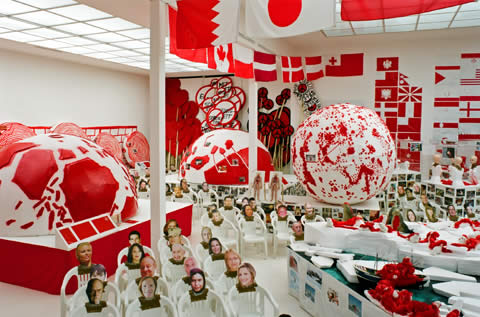
Substitution 2 (The Unforgettable) 2007
In 2011 S.M.A.K. and the Museum of Fine Arts in Ghent joined forces for a James Ensor retrospective entitled Hareng Saur: Ensor and contemporary art to celebrate 150 years since Ensor's birth (1860-1949).  The exhibition aimed to rediscover Ensor's work by comparing it to contemporary artists including Francis Alÿs, Jake & Dinos Chapman, Marlene Dumas, Thomas Hirschhorn, Bruce Nauman, Cindy Sherman, Thomas Schütte, among others. 

For the exhibition, S.M.A.K. selected Hirschhorn's Substitution 2 (The Unforgettable) described by Lisa Bradshaw in Flanders Today as an...
"...astonishing large-scale, mixed- media installation... which mixes photographs of war victims - bodies torn asunder and heads half missing - with magazine cut-outs of soldiers and average people blown up to life-size, numbers perched jauntily on their heads like hats, references to the number of dead.  Staged in the beautiful rotunda of the Fine Arts Museum, the installation is surrounded on an upper balcony by Ensor's series of the seven deadly sins. Hirschhorn's work is a visceral masterpiece..."
 Substitution 2 was previously shown in its entirety at Stephen Friedman in 2007, at the same time that Mark Wallinger's State Britain was on display at the Tate.  A full review of the Stephen Friedman show can be found here.  It includes the following quote from Hirschhorn when interviewed by Hannah Duguid, The Independent, February 2007.

"I want to invite people not to turn their eyes away from the non-positive"
If there was a question mark over Sasnal's political intentions (in my last post) there is no ambiguity here: Hirschhorn is an overtly political artist.  Hirschhorn (who has lived and worked in Paris since 1984) used to work for Grapus, a Communist aligned Graphics agency who rejected assignments from commercial or government clients, preferring to work with community groups, theatre groups, educational causes, social institutions and the Communist Party itself.  
They were also known for their technique called “detournement, the rerouting of a message through acts of visual vandalism,” in which they brought together various artistic mediums such as drawing, painting, photography, text, etc. After receiving the French Grand prix national des arts graphiques, the collective disbanded due to differing opinions as to an assignment with the Louvre.
Das Auge (The Eye) 2008
In 2008 Hirschhorn made Das Auge, which was first shown in Vienna (Secession 2008) and in 2011 it was used to represent Switzerland in the Venice Biennale.  In Hirschhorn's own words:
“Das Auge [The Eye] does not see everything – but it sees everything that is red. Das Auge only sees the colour red. Thus it can only show red, it can only name red, and it can only ‘be’ red.” 
Both Substitution 2 and Das Auge use the artist's signature materials: packing tape, cardboard, mannequins, and graffiti-like text reminiscent of handmade placards.  In November 2008 Hirschhorn gave a lecture at the Royal Academy of Arts (London) entitled Doing Art Politically: what does it mean?  in which Hirschhorn explained his position regarding making political art.  For Hirschhorn a) where you stand, what your position is and b) how this relates to others is central to making art (and for Hirschhorn this is making art politically - it is the political).  He talks about "touching the negative" (subject matter) and how, therefore it is important for an artist to remain positive: there's no point an artist complaining when they can "make a creation" (why contribute negativity?).  Hirschhorn believes that an artist has to make decisions.  Not choices like 'A' or 'B', 'Left' or 'Right' but "decisions".  Hirschhorn has decided that his work should 'touch' the four following areas at the same time:
  1. Love
  2. Esthetics
  3. Philosophy
  4. Politics
and he claims that while Love and Philosophy are positive, Esthetics and Politics could be negative.  It is unlikely that any one work of art will touch all four with the same intensity. 

For Hirschhorn Art is a tool used to confront reality, encounter the world we live in: a tool (or a weapon).  It is also a platform where contact can be made between the artist and the viewer: how do you reach the other? By using a door, a window or a hole.  This gives us a clue as to how we might read his work.  He also emphasises the importance of materials: he says that the artist makes the decision to use their materials and therefore must love their materials (without becoming kitsch, sentimental or obsessive). 

Hirschhorn also uses enigmatic guidelines.  Examples include:
  • Less is less, more is more
  • Quality no, energy yes
  • Panic is the solution
  • Better is always less good
  • To be responsible for everything that touches his artwork
  • To be the first who has to pay for his artwork

He claims that having guidelines helps to make art politically. He claims that he makes work for "the other" (not for the majority).  For Hirschhorn "the other" could be someone you don't know, someone you're afraid of or the other self that you have and he claims not to make art for himself but "for Art first" and then for "his art".

Hirschhorn's work looks naïve, it is anything but.  His installations are built up layers of narrative.  As Hirschhorn says (in the quote above) he wants to invite people not to turn away from the non-positive.  In this Hirschhorn

Monday, 5 September 2011

Top 10 Contemporary Political Artists: 10, Wilhelm Sasnal

Is Wilhelm Sasnal a Political artist?  I've always assumes that he is. His recent show at Sadie Coles HQ didn't appear as political as some of his previous works though.  There were statues evoking Socialist Realist sculptures (Untitled, left) but the press release tells us that the work has more to do with motherhood.  Here's how Hauser & Wirth describe his earlier work:
He references political events.  But then again, he references other things.  Is Sasnal political, or is he referencing the world he lives in, the world he has grown up in?  I can't remember when I first became aware of Sasnal's work, but I definitely saw him in the Hayward Gallery's 2007 show The Painting of Modern Life.  This would further suggest that Sasnal can be seen as someone who just paints "Modern Life", his modern life.  In the exhibition catalogue Sasnal talks about painting photographs:
"I tried to make the process of transferring a photographic image onto canvas as emotionless and mechanical as possible...the reworking of a motif provides an arena for interpretation and this is what interests me most....When it comes to choosing the source image, there really are no strict rules...in most cases the image finds me...". 

So, there we have it.  Sasnal is not political.  He chooses images randomly from books, while browsing the internet, or from film stills. It just so happens that he grew up in a communist country and therefore many of the images he finds from his childhood are seen in a political light by us in the West.  He surely is from a generation bewildered by the transition from a dearth of imagery during the Communist era to an influx of advertising imagery post Berlin Wall and the proliferation of internet based images.  This did happen quickly and merits some consideration.  But isn't the mere selection of images to paint political?  He may not be telling us his opinion on the political events he chooses to depict but by raising them to our attention is surely to give them importance.  His selection of images in some way memorialises them - sometimes taking a throw away image that might have been forgotten and imortalising it by rendering it as oil on canvas.  But his reasons for selecting the image are just as likely to be compositional as political.  Sasnal's work is about interpretation of images and the reductive process that occurs when painting a photograph.  Now, of course, interpretation is political.  Perhaps we need to find out what Sasnal has left out in order to discern his political stance.  Or perhaps not.  Perhaps this is the real potential for Sasnal's work to address the need outlined in my last post, that of imagining alternative possibilities.  Perhaps by not taking a stance, or not knowing the stance of an interpreted and altered image does "provide an arena for interpretation" as Sasnal purports to do.   His painterly grammar of drips and swirls allows us to enter into the image in a dreamlike fashion and in doing so allows us to imagine an alternate world.  Sasnal's paintings are spaces full of potential.  The source material is disparate and random.  Sasnal tells us that the work is about interpretation and the reductive process of painting photographic images - and we see this in many works where the paint swirls and drips take over the source image.  But there's just one thing bugging me: ultimately they are political though, aren't they?