 |
| Substitution 2 (The Unforgettable) 2007 |
For the exhibition, S.M.A.K. selected Hirschhorn's Substitution 2 (The Unforgettable) described by Lisa Bradshaw in Flanders Today as an...
"...astonishing large-scale, mixed- media installation... which mixes photographs of war victims - bodies torn asunder and heads half missing - with magazine cut-outs of soldiers and average people blown up to life-size, numbers perched jauntily on their heads like hats, references to the number of dead. Staged in the beautiful rotunda of the Fine Arts Museum, the installation is surrounded on an upper balcony by Ensor's series of the seven deadly sins. Hirschhorn's work is a visceral masterpiece..."Substitution 2 was previously shown in its entirety at Stephen Friedman in 2007, at the same time that Mark Wallinger's State Britain was on display at the Tate. A full review of the Stephen Friedman show can be found here. It includes the following quote from Hirschhorn when interviewed by Hannah Duguid, The Independent, February 2007.
"I want to invite people not to turn their eyes away from the non-positive"If there was a question mark over Sasnal's political intentions (in my last post) there is no ambiguity here: Hirschhorn is an overtly political artist. Hirschhorn (who has lived and worked in Paris since 1984) used to work for Grapus, a Communist aligned Graphics agency who rejected assignments from commercial or government clients, preferring to work with community groups, theatre groups, educational causes, social institutions and the Communist Party itself.
They were also known for their technique called “detournement, the rerouting of a message through acts of visual vandalism,” in which they brought together various artistic mediums such as drawing, painting, photography, text, etc. After receiving the French Grand prix national des arts graphiques, the collective disbanded due to differing opinions as to an assignment with the Louvre.
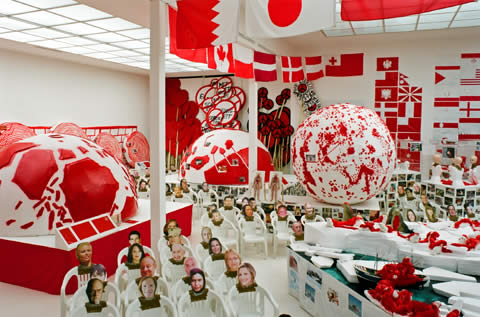 |
| Das Auge (The Eye) 2008 |
“Das Auge [The Eye] does not see everything – but it sees everything that is red. Das Auge only sees the colour red. Thus it can only show red, it can only name red, and it can only ‘be’ red.”Both Substitution 2 and Das Auge use the artist's signature materials: packing tape, cardboard, mannequins, and graffiti-like text reminiscent of handmade placards. In November 2008 Hirschhorn gave a lecture at the Royal Academy of Arts (London) entitled Doing Art Politically: what does it mean? in which Hirschhorn explained his position regarding making political art. For Hirschhorn a) where you stand, what your position is and b) how this relates to others is central to making art (and for Hirschhorn this is making art politically - it is the political). He talks about "touching the negative" (subject matter) and how, therefore it is important for an artist to remain positive: there's no point an artist complaining when they can "make a creation" (why contribute negativity?). Hirschhorn believes that an artist has to make decisions. Not choices like 'A' or 'B', 'Left' or 'Right' but "decisions". Hirschhorn has decided that his work should 'touch' the four following areas at the same time:
- Love
- Esthetics
- Philosophy
- Politics
For Hirschhorn Art is a tool used to confront reality, encounter the world we live in: a tool (or a weapon). It is also a platform where contact can be made between the artist and the viewer: how do you reach the other? By using a door, a window or a hole. This gives us a clue as to how we might read his work. He also emphasises the importance of materials: he says that the artist makes the decision to use their materials and therefore must love their materials (without becoming kitsch, sentimental or obsessive).
Hirschhorn also uses enigmatic guidelines. Examples include:
- Less is less, more is more
- Quality no, energy yes
- Panic is the solution
- Better is always less good
- To be responsible for everything that touches his artwork
- To be the first who has to pay for his artwork
He claims that having guidelines helps to make art politically. He claims that he makes work for "the other" (not for the majority). For Hirschhorn "the other" could be someone you don't know, someone you're afraid of or the other self that you have and he claims not to make art for himself but "for Art first" and then for "his art".
Hirschhorn's work looks naïve, it is anything but. His installations are built up layers of narrative. As Hirschhorn says (in the quote above) he wants to invite people not to turn away from the non-positive. In this Hirschhorn


